 info@workwearmanufacturer.co.uk


 Request a sample

Buyer guide
Private label workwear: how it works for UK brands
Updated 7 min readBy the Workwear Manufacturer team
Quick answer
Private label workwear is made by a manufacturer but sold under your brand — with your woven labels, swing tags, packaging and logo. You choose or adapt the garment specification, supply your artwork and label details, approve a sample, then the manufacturer produces the range. In the UK, the label must show the fibre composition; care labels and country of origin are optional but must not mislead.
Key takeaways
- Private label means your brand on the garment and packaging, made by a manufacturer to an agreed specification.
- White label is a generic stock product rebranded with minimal change; fully custom workwear is built from your own tech pack.
- You'll typically supply vector logos, colour references, label and swing-tag artwork, care and composition wording and packaging requirements.
- UK law requires fibre composition on textile labels. Care labels and country of origin are voluntary, but any claim must be accurate.
- Always approve a pre-production sample before bulk — it's your chance to check fit, fabric, branding and labels.
01.What is private label workwear?
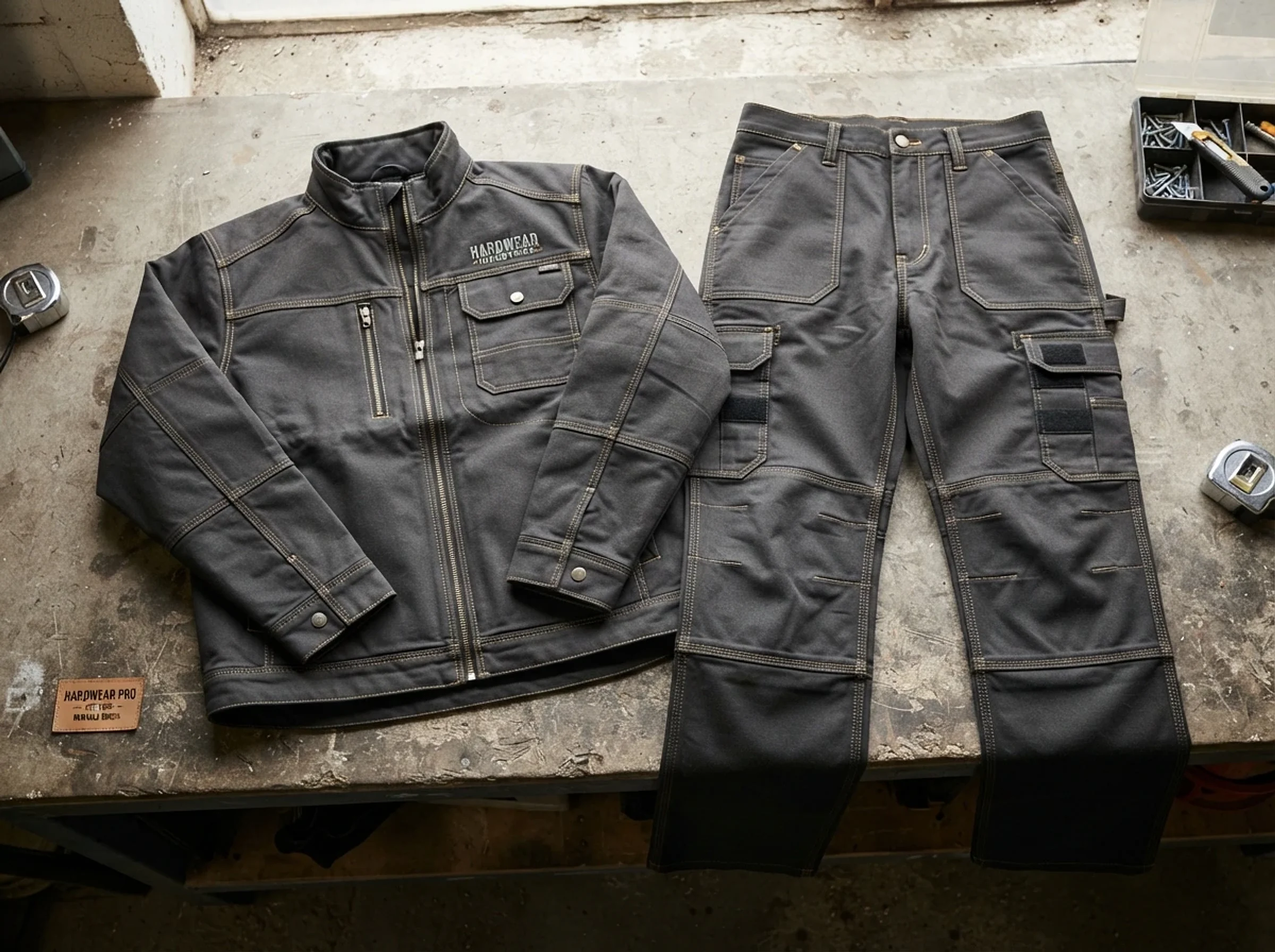
Private label workwear is clothing produced by a manufacturer and sold under another company's brand. The garments carry your neck labels, logo, swing tags and packaging, so customers see your brand — not the factory's. It's how many uniform suppliers, distributors and workwear brands build a range without owning a factory.
The garment itself can be one of the manufacturer's established styles, a modified version of one (different fabric, pockets or colours), or developed from scratch to your specification.
02.Private label vs white label vs custom
| Approach | What it means | Best for |
|---|---|---|
| White label | A generic stock garment rebranded with your logo, with little or no change to the product | Fast, simple branded uniforms |
| Private label | Garments made for your brand with your labels and packaging, often based on adapted manufacturer styles | Distributors and brands building their own range |
| Custom (cut, make, trim) | Garments developed from your own tech pack, fabric choices and measurements | Unique designs, specific sector needs, tenders |
In practice the lines blur — many private label ranges combine proven base styles with custom colours, trims and branding. See our workwear catalogue for the garment types we manufacture.
03.The private label process, step by step
- Define the range: garment types, fabrics, colours, sizes and quantities per style.
- Share your brand assets: logo files, label designs and packaging requirements.
- Quotation: the manufacturer confirms pricing, minimum order, lead time and branding options.
- Sampling: a pre-production sample with your branding and labels.
- Approval: sign off the sample, labels and packaging in writing.
- Bulk production: manufacturing, branding, labelling and packing to the approved sample.
- Quality checks and dispatch to your UK address or warehouse.
Workwear Manufacturer produces private label workwear from 25 pieces per style, with samples available before bulk. Request a quote to start.
04.What you need to supply
- Logo artwork as vector files (AI, EPS, PDF or SVG), plus Pantone or colour references.
- A tech pack or specification sheet — or clear reference photos or a garment to match.
- Neck label and swing tag designs, including sizes and materials (woven, printed, heat-transfer).
- Fibre composition and care wording for each garment.
- Packaging requirements: polybags, folding, barcodes or SKU stickers and carton labelling.
- Size range and size ratio for each style.
Not sure about branding methods? Our guide to embroidery vs printing for workwear explains the options.
05.UK labelling rules for private label workwear
Fibre composition: required
Textile products sold in the UK must be labelled with their fibre composition, using the approved fibre names and showing each component. This comes from the Textile Products (Labelling and Fibre Composition) Regulations 2012 and the retained EU textile regulation. See GOV.UK's textile labelling guidance.
Country of origin: optional
The textile rules don't require a country of origin, but if you show one it must be accurate and not misleading.
Care labels: recommended
Care labels aren't a legal requirement in the UK, but they're expected by buyers and help garments last. The familiar care symbols are trademarks of GINETEX, licensed in the UK through UKFT.
06.Tips for a successful private label range
- Start with a small pilot order to test fit and demand before scaling up.
- Keep core colours consistent across styles so repeat orders match.
- Record the approved sample and specification so reorders are made the same way.
- Plan lead times around your selling season — sampling and bulk production take time.
Sources
This guide is general information for UK buyers, not legal, tax or customs advice. Rules change, so check the latest GOV.UK guidance for your order.
