 info@workwearmanufacturer.co.uk


 Request a sample

Buyer guide
How to source workwear from Pakistan: a UK buyer's guide
Updated 9 min readBy the Workwear Manufacturer team
Quick answer
UK businesses can import workwear made in Pakistan with 0% customs duty on most clothing under the UK's Developing Countries Trading Scheme (DCTS), provided the goods meet the rules of origin and come with a valid proof of origin. You'll still pay 20% import VAT, need a GB EORI number and a customs declaration, and should agree samples, specifications and any PPE certification before bulk production.
Key takeaways
- Pakistan is in the DCTS Enhanced Preferences tier, which removes customs duty on most clothing — compared with a standard 12% on many workwear lines.
- To claim 0% duty you need a valid proof of origin, such as an origin declaration on the invoice. REX numbers can't be used under the UK scheme.
- Since 1 January 2026, garments need only one significant process — such as cutting and sewing — in Pakistan to qualify, even if the fabric comes from elsewhere.
- Import VAT at 20% still applies; VAT-registered businesses can usually account for it through postponed VAT accounting.
- Hi-vis and flame retardant garments sold as PPE must meet the relevant standards. Agree the certification route and check the documents before you order.
01.Why UK buyers source workwear from Pakistan
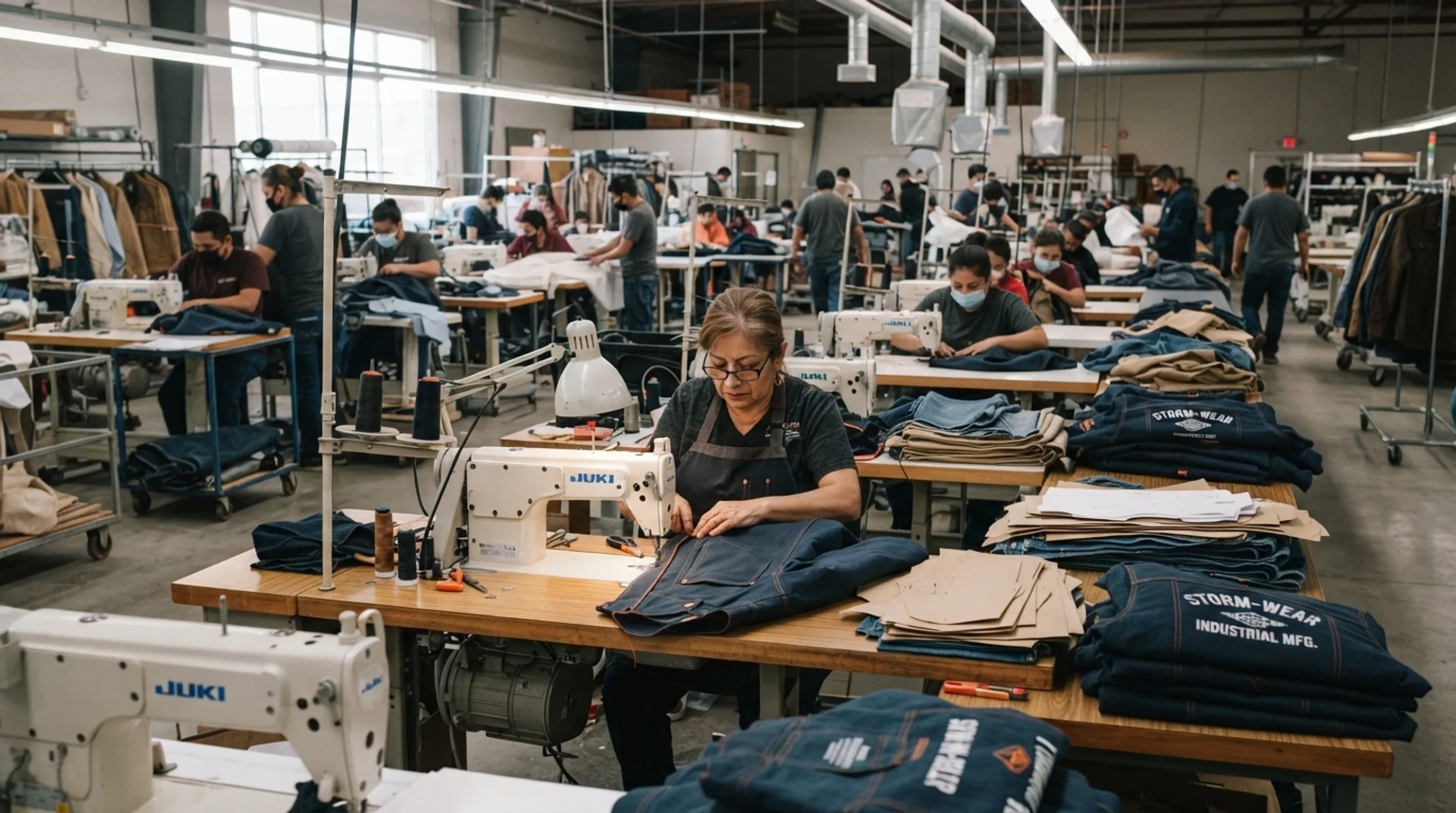
Pakistan has a large, long-established textile and garment industry, and Sialkot in Punjab is one of its best-known export manufacturing centres — known for sportswear, gloves, leather goods and team and martial arts uniforms as well as workwear. For UK buyers, that means access to experienced cut-and-sew production, fabric and trim suppliers, and factories used to working to buyers' specifications.
The biggest commercial draw is trade terms. Under the UK's Developing Countries Trading Scheme (DCTS), most clothing from Pakistan can enter the UK with no customs duty, which can make a meaningful difference to landed cost compared with suppliers from countries that pay the standard rate.
Minimum order quantities vary widely between factories. Some work only in thousands of pieces per style; others, including Workwear Manufacturer, take wholesale orders from 25 pieces per style — useful for pilot runs, smaller uniform contracts and testing new ranges.
02.UK import duty on workwear from Pakistan (DCTS)
The DCTS replaced the UK's previous preference scheme in June 2023. Pakistan sits in the Enhanced Preferences tier, which gives duty-free access on around 92% of tariff lines. The UK government has highlighted clothing — jeans, for example — as products where the standard 12% duty falls to 0% for Pakistani exports.
| Garment (example) | Commodity code (example) | Standard UK duty | Under DCTS (Pakistan) |
|---|---|---|---|
| Men's industrial/occupational trousers, cotton | 6203 42 11 00 | 12% | 0% with valid proof of origin |
| Men's industrial/occupational trousers, synthetic | 6203 43 11 00 | 12% | 0% with valid proof of origin |
| Men's industrial/occupational jackets, cotton | 6203 32 10 00 | 12% | 0% with valid proof of origin |
| Bib and brace overalls, cotton | 6203 42 51 00 | 12% | 0% with valid proof of origin |
| Women's industrial/occupational trousers, cotton | 6204 62 10 00 | 12% | 0% with valid proof of origin |
03.Rules of origin and proof of origin
Duty-free access only applies if the garments count as originating in Pakistan under the DCTS rules — and you can prove it.
The 2026 garment rules
From 1 January 2026, Enhanced Preferences countries such as Pakistan use the same relaxed rules for clothing (chapters 61 and 62) as the least developed countries. In most cases only one significant process, such as cutting and sewing, needs to take place in Pakistan, so fabric and trims can be sourced from other countries. Proofs of origin must be dated on or after 1 January 2026 to use the new rules.
Acceptable proof of origin
- An origin declaration (statement on origin) on a commercial document such as the invoice, packing list or delivery note, containing the wording and details HMRC requires. It's valid for two years.
- A Form A certificate of origin. The UK doesn't require it to be stamped by the exporting country's customs authority.
Importer's knowledge is no longer accepted as a proof of origin under DCTS, and exporter numbers from the EU's REX system can't be used on a UK DCTS origin statement. Exporters must keep records that support the origin claim for three years. Confirm the exact wording and any exporter reference with your customs agent or GOV.UK's DCTS guidance.
04.Import VAT, EORI and customs declarations
- EORI number: you need a GB EORI number to import goods into Great Britain. It's free and usually quick to get.
- Import VAT: 20% is charged on the customs value plus any duty, freight and insurance. VAT-registered businesses can normally use postponed VAT accounting to account for it on their VAT return instead of paying at the border.
- Customs declaration: most businesses use a freight forwarder or customs agent to submit the import declaration and claim the DCTS preference on their behalf.
- Documents to request from the supplier: commercial invoice (with the origin declaration), packing list, and the air waybill or bill of lading.
05.Incoterms: who pays for what
Incoterms set out where responsibility and cost pass from seller to buyer. Agree them in writing on every quotation.
| Incoterm | What the supplier covers | What you cover |
|---|---|---|
| EXW (Ex Works) | Goods ready at the factory | Collection, export clearance, freight, insurance, UK import costs |
| FOB (Free On Board) | Delivery onto the vessel at the port (sea freight only) | Sea freight, insurance, UK import costs |
| DAP (Delivered At Place) | Carriage to your named UK address | UK duty, VAT and import clearance |
| DDP (Delivered Duty Paid) | Everything, including UK duty and VAT | Unloading — but check the supplier can genuinely act as UK importer |
06.Shipping options and lead times
Lead time is made up of sampling, bulk production and transit. The figures below are typical ranges, not guarantees — they vary with season, carrier and customs checks.
- Air freight or express courier: roughly 3–7 days door to door. Best for samples, urgent replenishment and smaller orders.
- Sea freight from Karachi or Port Qasim to UK ports such as Felixstowe or Southampton: roughly 25–40 days port to port, plus haulage and clearance. Usually the lowest cost per piece for large bulk orders.
For reference, our sample production is estimated at 5–7 working days, with UK delivery estimated at 7–10 working days after dispatch. Bulk lead times are confirmed with each quotation.
07.Step-by-step: how a workwear sourcing order works
- Brief: share garment types, quantities per style, fabric preferences, colours, sizes, branding and target delivery date. A tech pack helps, but photos and reference garments work too.
- Quotation: the manufacturer confirms pricing, materials, MOQ, lead time and Incoterms.
- Sample: a pre-production sample lets you check fit, fabric, construction and branding before committing.
- Approval: sign off the sample and the final specification in writing.
- Bulk production: cutting, sewing, branding and finishing to the approved sample.
- Quality checks: in-line and final inspection against the agreed specification. Some buyers also appoint an independent inspector.
- Shipping documents: commercial invoice with origin declaration, packing list and transport documents.
- Customs clearance and delivery: your agent clears the goods and claims the DCTS preference.
Ready to start? Request a wholesale quote or browse our workwear catalogue.
08.Hi-vis and flame retardant workwear: compliance checks
If you're buying hi-vis or flame retardant garments that will be used as personal protective equipment (PPE), they must meet the PPE Regulation as it applies in Great Britain and the relevant standards — for example EN ISO 20471 for high-visibility clothing and EN ISO 11612 for heat and flame protection.
Since 1 October 2024, the UK government has recognised CE marking indefinitely for PPE placed on the GB market, alongside UKCA marking. See GOV.UK's guidance on continued recognition of CE marking.
See our hi-vis clothing and flame retardant workwear ranges — certification requirements are discussed and confirmed with each enquiry.
Sources
- GOV.UK — New UK trade scheme paves the way for an increase in Pakistani exports
- GOV.UK — How to claim preferences under the DCTS
- GOV.UK — Improved rules of origin under the DCTS are now in effect
- UK Trade Tariff — look up commodity codes and duty
- GOV.UK — Get an EORI number
- GOV.UK — VAT on imports
- GOV.UK — Continued recognition of CE marking for placing products on the GB market
This guide is general information for UK buyers, not legal, tax or customs advice. Rules change, so check the latest GOV.UK guidance for your order.
